
Maps of Feeling
Building an intuitive way of talking about and moving between emotions

Emotions are not characters or colours, as they are commonly depicted in children’s fiction. Rather than fixed points with specific traits, emotions are wide basins with many possible expressions. The metaphor of the emotional landscape offers a rich language to discuss and steer the relationship between organism and environment.
More than a metaphor, understanding how different variables interact actually presents us with a map of the space that emotional life occurs in. Whilst the map is never the territory, and the real dimensions of affect are innumerable, this exercise gives us a very useful intuition for talking about how emotions affect behaviour and transition from one to another.
These dimensions are settled science, to the best of my knowledge. The two dimensions emerge from statistical dimensionality reduction techniques; a kind of redundancy test showing that variations in descriptions of emotional states can be collapsed into just two terms: Valence and Arousal.
Valence accounts for the pleasant or unpleasant quality of an experience, and Arousal describes the levels of energisation felt. Negative emotions (or unpleasant emotions, as some call them) sit on the lower end of the Valence dimension, but can be either side of Arousal. The same is true for positive emotions, which can be differentiated by their felt energy levels.
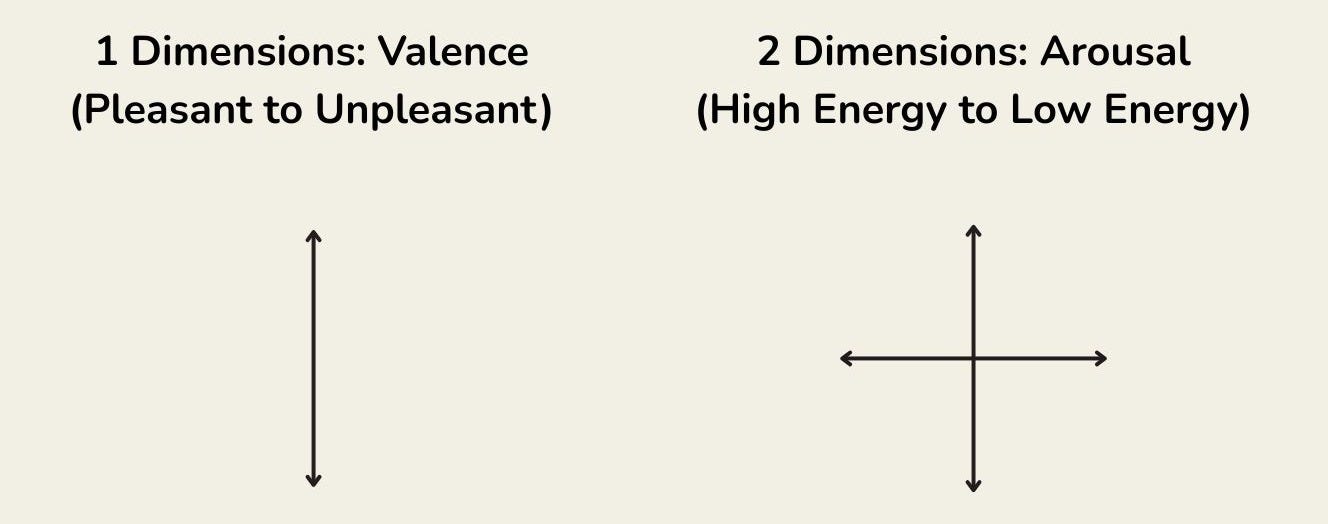
Within this very simple model, we have a precise way of talking about emotional experiences, and even intuiting pathways between emotional states.
Depression
For example, we can see that depression sits very low on the side of both valence and arousal, meaning it is a state of low energy and low pleasure. If we move from depression directly into a high arousal state, we risk creating “agitated depression”¹ - a clinically recognised state associated with irritability, restlessness and increased risk of self-harming behaviours. Agitated depression is particularly dangerous because the person retains the hopelessness of depression but gains the energy to act on it. ²
Where depression interventions like Cognitive Behavioural Therapy are typically focused on decreasing negative affect, emerging lines of research demonstrate promising results for treating depression with positive affect based interventions. As Michelle Craske put it: “We had always assumed that by reducing negative emotions - anger, fear, anxiety, sadness - the natural consequence would be for positive emotions to rise on their own. And they don’t - well, not reliably.” ³
Positive Affect Treatment works by targeting three systems that contribute to positive valence: the dopaminergic “Wanting” system, the opioid “Liking” system, and reward learning - the process of encoding connections between actions and positive outcomes. In clinical trials, PAT produced meaningfully greater improvements in both clinical outcomes and reward sensitivity compared to standard Negative Affect Therapy, with a particularly striking reduction in suicidal ideation (1.7% vs 12.0% at six-month follow-up).
Anxiety
On the landscape, anxiety sits in a valley of high arousal and low valence. We have energy, but not direction. This feels unpleasant, and often overwhelming. Looking at the map, we would want to move anxiety to a positively valenced basin, like Joy (high arousal + high valence) or Serenity (low arousal + high valence).
Anxiety is a nuanced topic, because whilst it always responds to uncertainty, it can manifest in different ways. These manifestations tend to take two main shapes: collapsed and rigid. In the collapsed case, uncertainty is managed by hyper-vigilance: nothing is predictable, and therefore nothing is trustworthy. This tends to produce motor control that is clumsy and cognitive control that is unfocused. On the other hand, uncertainty can be managed by rigid control: because the world is uncertain, I need to make my own reactions predictable. This tends to produce control that is inflexible and misattuned to the environment.
These two models of anxiety would naturally occupy different basins on the map, and would require different inputs to be destabilised. For the collapsed individual, the classic path out of anxiety may prove the most robust. In the 1970’s, Jeffrey Alan Grey hypothesised the Behavioural-Inhibition-System (BIS): a neural-hormonal network that modulates approach behaviours. When the organism was focused on a goal, the BIS would switch off, directing energetic resources towards a specific point in the environment. But when the organism lost sight of their goal, they would stop moving and often engage in anxious-like behaviours.
Whilst anxiety is a “high energy” basin, that energy is not directed. For the collapsed type, directing that energy may provide a means of escaping the anxiety basin. This relationship between anxiety and behavioural inhibition is one of the strongest in psychological research. Grey’s complementary system, the Behavioural Activation System (BAS), provides the mechanism: where the BIS inhibits action under uncertainty, the BAS drives approach behaviour toward specific goals. For collapsed-anxious types, activating the BAS may allow them to move from high arousal, low valence basins into high arousal, high valence - not by reducing their energy, but by giving it a target. This is a different operation to treating depression. With depression, we gradually increase valence while the system is at low energy. With collapsed anxiety, we redirect existing high energy across the valence landscape by pointing it somewhere. Of course, there is still a need to discover basins of low arousal, high valence, but this is still an interesting observation.
Unlike the collapsed type, the rigid-anxious person may not actually benefit as much from behavioural activation therapies. Their problem is not where, but how. For the rigid person is stiff and inflexible, and their way of moving is energetically costly. To traverse the landscape into a positive valence state, they may pursue the pleasure systems of Liking and of Safety.
Joy
Joy is a state of high valence and high arousal, where the organism is optimally balanced in pursuit of a goal. Whilst this definition does not sit right with everyone, I feel it is useful to differentiate joy from serenity as high and low arousal positive affects.
Because Joy occupies a high arousal basin, we know it has something to do with goal orientation. Research suggests that the arousal system is mediated by goal velocity, the rate at which one feels they are closing in on a goal. In this way, we tend to feel joy in contexts where there is a level of tension - be that the tension of keeping rhythm in dance, winning a game or jumping across a rooftop.
In a state of joy, our behaviour becomes very open. We are more extroverted, suggesting the presence of the behavioural activation system, but also more explorative. High dopamine in positive affect allows the easy switching of focus that enables playfulness. Playfulness, the search for possibility, is a pathway to joy; as it involves pleasure, excitement and novelty.
Serenity
In the final quadrant, we find Serenity. Serenity is a high valence, low arousal state from which we gain an unconditional wellbeing. Where joy is more dependent on external circumstances, Serenity comes to us through conditions of self-acceptance and regular immersion into peaceful practices.
What actually increases Serenity is contentious, but one of the most convincing theories comes from Michael Edward Johnson’s Symmetry Theory of Valence, which postulates that the more harmony within the body and between the senses, the more pleasure we feel. ⁴ Pleasure, in this framing, is about rhythm, harmony and synchronisation. In this way, we might say that serenity stabilises the topography by increasing its symmetry.
Its stabilising effect suggests how we can move towards it: whatever creates smoothness will tend to increase serenity. Many practices have been developed to cultivate this quietly powerful state, but the simple act of regularly engaging in peaceful moments or “inner havens” is the key condition.
The low arousal state of Serenity can accommodate stressful moments by buffering them. As Josh Waitzkin said: “The better we are at recovering, the greater potential we have to endure/perform under stress.” The stabilising effect of Serenity is immensely powerful for moderating performance and keeping anxious motor control breakdowns at bay. This is a rich space for exploration and development for any Emotional Athlete.
Stabilising and Destabilising the Landscape
In the language of dynamic systems, landscapes can change through stabilisation or destabilisation. Stabilisation means that the landscape retains a characteristic. The deep pit of depression is an example of excessive stability, or stability in an undesirable basin.
As we have discussed, such an excessively stable basin requires destabilising. Depression is described as the “locked in” brain, where the brain becomes insensitive to the surprises that would cause changes to occur. Gradual education in positive affect teaches the landscape that it can change.
In this way, stability can be good or bad depending on what is being stabilised. A general rule of thumb would be that high arousal states tend to be destabilising and low arousal states tend to be stabilising - though some high arousal states, like anxiety, can become deeply entrenched. What keeps an anxious basin stable is not the arousal itself but the self-reinforcing cycle of vigilance and avoidance that maintains it.
Furthermore, there is interesting research about transitioning between unstable and stable, or high arousal and low arousal states. Analogous to metal being repaired through a process of heating and rapid cooling, the brain may increase plasticity through high to low arousal transitions. This process, called Neural Annealing, is present in concepts like Spaced Repetition, but may be leveraged in some interesting ways in motor learning, such as transitioning between high and low arousal states, or increasing ease of access to “inner havens”.
¹ Agitated depression as a mixed state and the problem of melancholia
² “Antidepressants may rapidly energize an anergic patient before reversing their depressed mood such that a potentially suicidal patient may remain depressed but be provided with enough energy to act on preexisting suicidal ideations”
Antidepressant‐Induced Suicidality: An Update
³ “We had always assumed that by reducing negative emotions - anger, fear, anxiety, sadness - the natural consequence would be for positive emotions to rise on their own. And they don’t - well, not reliably.”
New Psychotherapies That Focus on Positive Experiences Could Better Treat Depression and Anxiety
⁴ “Suffering is lack of harmony in the mind” Principia Qualia, Michael Edward Johnson